Vietnam’s Maritime Hubs Strengthen Global Position
Lloyd’s List placed Ho Chi Minh City’s container terminal at 22nd globally, recording more than 8.9 million TEU in 2023—a 14.5% rise on the previous year. Hai Phong followed at 26th with over 8.2 million TEU and a 16% growth, while the Cai Mép‑Thị Vải complex held the 31st spot. This marks the sixth consecutive year the three Vietnamese ports appear in the Top 100 list, underscoring their growing role in international supply chains. Alphaliner’s mid‑year data corroborated the trend: Ho Chi Minh City advanced to 19th among the world’s busiest ports, and Hai Phong to 25th, with the latter moving 96 million tonnes of cargo in the first half of the year, up 11.4% YoY. Cai Mép‑Thị Vải logged 3.9 million TEU, a 9.2% increase, ranking 29th in the same period.
Ambitious Expansion Agenda
The surge is backed by an ambitious expansion agenda. Decision 1061/QĐ‑BXD 2026 designates the southern region, especially Ho Chi Minh City, as a strategic national port zone. The city’s port system now includes deep‑water facilities at Cai Mép‑Thị Vải, capable of receiving 250,000‑tonne super‑container ships and ranking among the world’s top‑20 fastest‑growing ports. Over 30 berths operate there, handling roughly 30% of Vietnam’s container traffic, with nearly 50 weekly international services, including more than 20 direct routes to Europe and the Americas.
New Projects Underway
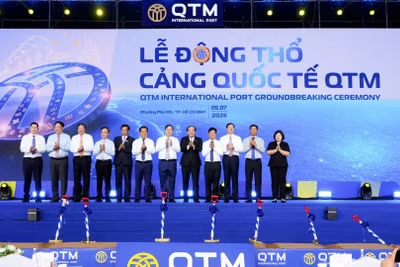
New projects are under way: the QTM international port in Phú Mỹ, launched in July 2026, carries a VND 6.9 trillion investment; the integrated Cai Mép‑Ha container hub exceeds VND 50,800 trillion; and the Can Giơ transshipment terminal involves a US$5 billion outlay. Throughput is projected to reach 500 million tonnes annually by 2030, cementing Ho Chi Minh City’s status as a pivotal maritime gateway for the region.